


| English | Korean | Chinese | Japanese |
AI-Powered Event Detection
Traditional CCTV systems rely on human operators to review footage, a process that is time-consuming and prone to errors. The new system integrates AI to automatically analyze video feeds, identifying events such as car accidents, wildfires, and security breaches.
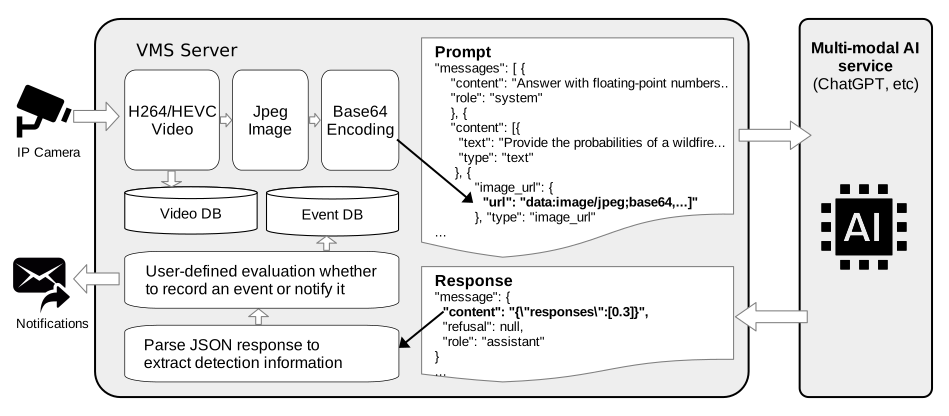
How It Works:
The system sends video frames to ChatGPT or other LLM servers for real-time analysis, providing instant reports to help users respond promptly.
Use Cases:
· Traffic Monitoring: Detect car accidents and alert emergency services.
· Wildfire Detection: Spot early signs of wildfires.
· Security Breaches: Identify unauthorized access or suspicious activities.

Evaluation Guide
Response Variables from AI
The following read-only variables store the results from the AI model:
· res: Boolean, either true or false
· resA, resB, resC, resD: integers or floats.
· str : text.
Control Variables
The following variables are set by the user to control the event log and notifications:
· record_event: indicates whether to record an event (true or false).
· notification: indicates whether to send a notification (true or false).
// Log event if the sum of resA and resB is greater than one.
record_event := resA + resB > 1;
// Log event if the variable resA is greater than 0.5 and
// the variable resB is less than 0.5.
record_event := resA > 0.5 and resB < 0.5;
// Log event if the string variable str is not empty.
record_event := str != '';
// Send notification if both resA and resB exceed five.
notification := resA > 5 and resB > 5;
// Send notification if the string variable str contains 'apple'.
notification := 'apple' in str;
Miscellaneous Variables
The following variables can be used to store miscellaneous information: count and time_notification are set by the user and persist between evaluations:
· count: An integer used to count events or other occurrences.
if (res == true)
  count += 1; // If res is true, increment count.
else
  count := 0; // Otherwise, reset count.
// If count exceeds three, send a notification.
notification := count > 3;
· time_now: the current timestamp.
· time_notification: the timestamp of the last notification (set by the user).
// If more than 10 seconds have elapsed since the last
// notification and count exceeds three, send a notification
// and reset time_notification.
if (time_now - time_notification > 10 and count > 3) {
  notification := true;
  time_notification := time_now;
} else {
  notification := false; // Otherwise, do not send a notification.
}
For more information about the syntax of the evaluation program, please refer to:
· C++ Mathematical Expression Library 
· Revolutionizing CCTV: AI-Powered Event Detection with ChatGPT